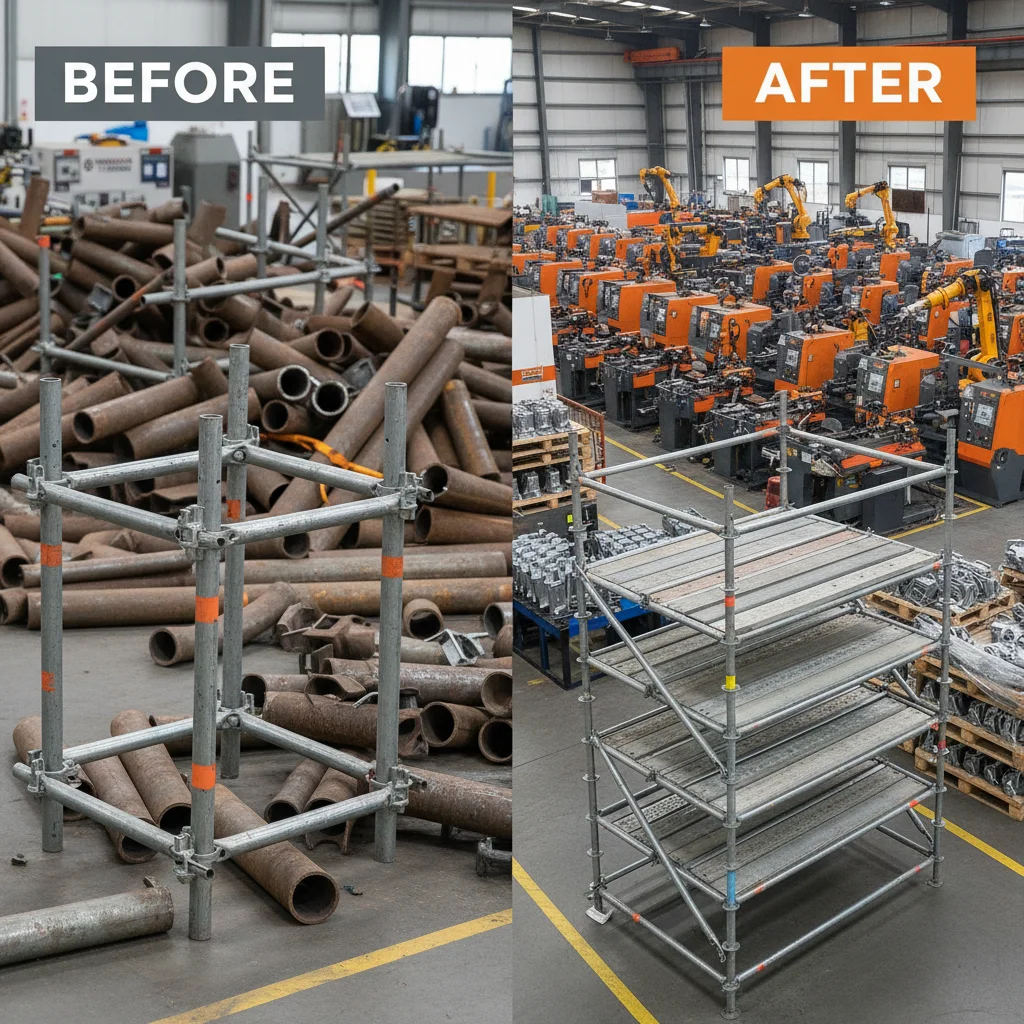
A scaffolding coupler factory specializes in the precision engineering and mass production of critical connecting components used to join scaffolding tubes together. These couplers serve as the primary structural joints, ensuring that vertical standards and horizontal ledgers remain locked in place under immense pressure. By utilizing high-grade steel and specialized casting or forging processes, these factories provide the essential hardware that prevents structural collapse on construction sites worldwide.
In the demanding environment of heavy construction, the failure of a single coupler can lead to catastrophic systemic instability. Procurement managers and engineers often struggle with balancing cost-efficiency against the rigorous safety standards required for high-rise projects. This challenge is compounded by the exposure of equipment to moisture and chemical agents, which can lead to rapid corrosion and a significant decrease in load-bearing capacity over time.
This article provides a comprehensive technical analysis of coupler manufacturing and selection. We will explore the critical material specifications, the impact of surface treatments on longevity, and a comparative evaluation of different coupler types. Whether you are optimizing a supply chain or overseeing site safety, this guide will help you identify the benchmarks of a high-quality scaffolding coupler factory to ensure maximum project stability.

1Foundations of Coupler Manufacturing

The production of scaffolding couplers involves a sophisticated blend of metallurgy and precision casting. A professional scaffolding coupler factory typically employs automated forging or drop-hammering techniques to ensure that the grain structure of the steel is optimized for stress distribution. This process is vital because couplers must resist deformation when subjected to high torque during tightening and heavy vertical loads during use.
Beyond the forming process, the precision of the threading is where quality is truly determined. Poorly machined threads can lead to slippage or "stripping," which compromises the integrity of the entire scaffold. High-end factories utilize CNC machining to ensure that every bolt aligns perfectly with the internal nut, allowing for a secure, airtight lock.
Finally, the integration of quality control systems, such as ISO 9001, ensures that every batch is tested for tensile strength and hardness. This systemic approach transforms a simple piece of hardware into a certified safety component capable of supporting thousands of pounds of equipment and personnel.
2Critical Technical Specifications
When evaluating a scaffolding coupler factory, the material grade is the most important specification. Most industry-standard couplers are manufactured from Q235 high-strength steel or equivalent alloys. This material provides the necessary balance between ductility—allowing the coupler to absorb some shock—and hardness, which prevents the metal from shearing under extreme weight.
Surface treatment is the second critical factor. In humid or coastal environments, raw steel will oxidize rapidly. Hot-dip galvanization is the gold standard, creating a thick zinc layer that protects the steel from oxygen and moisture. Some factories offer industrial powder coating, which is effective for indoor use but lacks the deep-pore protection of galvanization.
Tolerance levels also play a significant role. A coupler must fit a standard 48.3mm tube snugly. If the tolerance is too loose, the joint will wobble; if too tight, the installation process becomes inefficient. Precision-engineered couplers maintain a tolerance of ±0.1mm, ensuring rapid deployment without sacrificing stability.
3Industrial Application Scenarios
Couplers are not one-size-fits-all; they are deployed based on the specific geometry of the scaffold. Right-angle couplers are used for the primary intersections of standards and ledgers, while swivel couplers allow for adjustable angles, which is essential for bridging uneven terrain or creating curved structural supports in bridge engineering.
In high-load concrete formwork, heavy-duty sleeve couplers are employed to create continuous vertical supports. These are designed to handle massive compressive forces, preventing the formwork from bowing or collapsing during the pouring phase. The ability of a factory to provide specialized couplers for these niches determines their versatility as a partner.
Furthermore, in municipal infrastructure projects, such as tunnel maintenance, corrosion-resistant couplers are non-negotiable. The presence of groundwater and chemical runoff requires the use of premium galvanization to prevent premature failure, ensuring that the maintenance platforms remain safe for long-term use.
4Performance Metrics and Load Analysis
The performance of a coupler is measured by its "slip load"—the amount of force required to cause the tube to slide through the coupler. A high-quality scaffolding coupler factory designs its products to maximize this resistance through optimized clamping surface area and precise bolt tensioning. This ensures that the joint remains rigid even under dynamic loading.
Load distribution is another key metric. When a coupler is tightened, it creates a concentrated point of pressure on the tube. Superior designs distribute this pressure more evenly across the tube's circumference, reducing the risk of the tube buckling at the connection point, which is a common failure mode in low-quality systems.
scaffolding coupler Factory Performance Metrics
Data indicates that certified couplers from specialized factories exhibit significantly lower failure rates in shear tests. By adhering to international standards such as EN 74 or BS 1139, these components provide predictable performance, allowing engineers to calculate safety factors with higher confidence.
5Procurement and Quality Benchmarks
Procuring from a reputable scaffolding coupler factory requires more than just a price comparison. Buyers should request mill test certificates (MTC) to verify the chemical composition of the steel. This prevents the use of recycled scrap metal that may contain impurities, which can lead to brittle failure under cold temperatures.
The consistency of the product is another benchmark. In a shipment of 10,000 units, every single piece must perform identically. Factories that utilize automated optical inspection (AOI) can detect microscopic cracks or threading errors that human inspectors might miss, ensuring a zero-defect delivery.
Finally, consider the total cost of ownership. While cheaper couplers may save money upfront, their shorter lifespan and higher replacement rate—due to corrosion or wear—often make them more expensive over the project's lifecycle. Investing in hot-dip galvanized products from a certified factory typically yields a higher ROI through reuse.
6Innovation in Structural Connectivity
The industry is moving toward "press-fit" and "wedge-lock" systems to replace traditional bolt-and-nut couplers. These innovations aim to reduce installation time and eliminate the risk of under-tightening. Modern factories are investing in the tooling required to produce these high-precision modular components, which snap into place with a secure, audible click.
Another trend is the use of advanced alloy coatings that provide superior protection compared to standard zinc. Some factories are experimenting with zinc-aluminum-magnesium (ZAM) coatings, which offer self-healing properties—meaning that if the surface is scratched, the surrounding coating reacts to protect the exposed steel.
Digital integration is also entering the factory. ERP-based intelligent management allows for end-to-end traceability, where every coupler batch can be traced back to the specific raw material heat number and the machine operator, ensuring absolute accountability in safety-critical applications.
7Selection Guide for Global Projects
Selecting the right coupler depends on the project's specific constraints, including the local climate, the planned height of the structure, and the available labor skill level. For projects in high-humidity zones, the priority must be the thickness of the galvanization layer to prevent structural decay.
For complex architectural shapes, a mix of right-angle and swivel couplers is necessary. Engineers should ensure that the factory can provide a compatible range of accessories, such as base plates and screw jacks, to ensure that all components work together as a single, cohesive system.
| Coupler Type | Primary Use Case | Key Strength | Limitation |
|---|---|---|---|
| Right-Angle | Main Frames | Maximum Stability | Fixed Geometry |
| Swivel | Bracing/Curves | Angle Flexibility | Lower Load Limit |
| Sleeve | Vertical Extension | High Compression | No Angular Pivot |
| Putlog | Ledger Support | Rapid Install | Specific Tube Fit |
| Modular | Fast-Track Projects | Assembly Speed | Higher Unit Cost |
| Heavy-Duty | Concrete Formwork | Extreme Load | Increased Weight |
Ultimately, the choice of a scaffolding coupler factory should be based on a balance of certified quality, material transparency, and the ability to scale production. By focusing on technical specifications rather than just price, contractors can ensure a safe and efficient construction process.
Frequently Asked Questions
Conclusion
Choosing the right scaffolding coupler factory is a critical decision that directly impacts the safety of every worker on a construction site. By prioritizing forged steel, hot-dip galvanization, and certified precision machining, procurement teams can mitigate the risks of structural failure and reduce long-term maintenance costs. A focus on technical specifications and material transparency ensures that the structural joints of a project are as reliable as the foundations themselves.
For those seeking to upgrade their structural hardware or evaluate new suppliers, reviewing detailed technical data and certification reports is the most effective path. Professionals can explore a wide range of safety-engineered construction support solutions and certified coupler options at www.sheenmetalscaffold.com to ensure their projects are built on a foundation of reliability and innovation.