
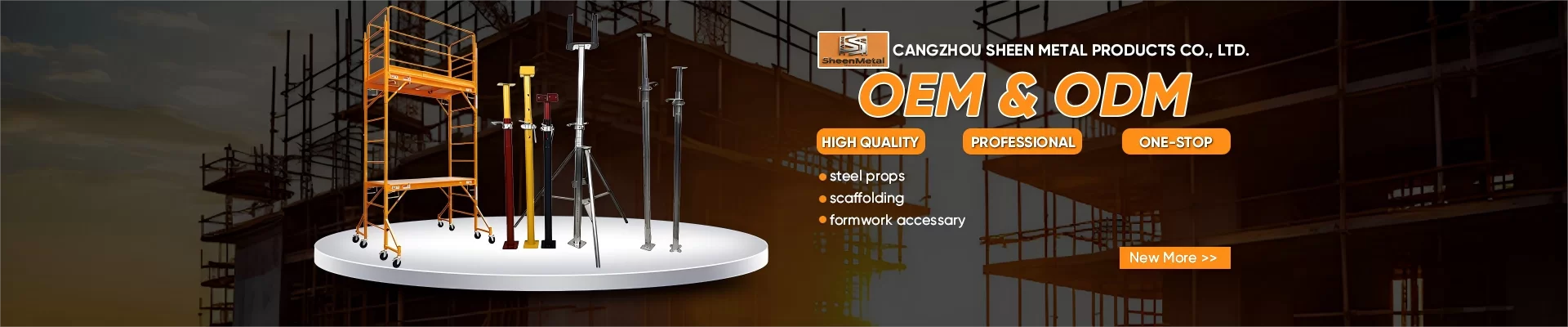

Temporary structural supports, often sourced from a professional steel prop Factory, are critical components in modern civil engineering and construction. These systems provide the necessary vertical load-bearing capacity to support slabs, beams, and other structural elements during the curing process or during renovation. This article examines the technical requirements, material specifications, and procurement standards necessary for selecting high-performance architectural support systems.
In the B2B construction sector, the shift toward modularity and high-precision manufacturing has redefined how support props are evaluated. From deep excavation projects to municipal infrastructure, the demand for safety-engineered solutions requires a deep understanding of load capacity, material fatigue, and environmental durability. Understanding these technical drivers helps project managers reduce operational risks and optimize project timelines.
Readers will explore the critical dimensions of prop selection, including galvanized steel specifications, international safety certifications, and the impact of automated production on product consistency. By analyzing these factors, procurement officers can establish a rigorous framework for supplier evaluation, ensuring that the chosen support systems meet the specific load-bearing demands of their unique project environments.
Industrial Support Systems Foundation
The fundamental purpose of a steel prop system is to transfer vertical loads from the upper structural levels to the foundation or a stable lower level. This process requires not only raw strength but also high dimensional stability to prevent buckling or shifting under pressure. Modern manufacturing utilizes high-grade carbon steel and advanced welding techniques to create a rigid structure capable of withstanding significant axial compression. In complex engineering scenarios, such as tunnel construction or bridge repair, these props must be integrated with couplers and base plates to form a cohesive support network. The evolution from manual fabrication to automated production lines has significantly reduced human error, ensuring that every prop maintains a consistent wall thickness and precise thread pitch, which is essential for safe height adjustment and load locking.
Technical Procurement & Evaluation
When evaluating architectural support systems, the focus must shift from simple unit cost to total structural reliability and lifecycle value. The following analysis details the seven critical dimensions that define the quality and suitability of high-performance steel props for industrial applications.
Material Grade & Structural Integrity
The structural capacity of a prop is directly tied to the steel grade and the thickness of the pipe wall. High-precision welded pipes crafted from premium steel offer superior strength-to-weight ratios and resist deformation under extreme loads. Procurement teams should verify the chemical composition of the steel to ensure it possesses the necessary yield strength for the intended application.
| Steel Specification | Key Property | Project Application | Evaluation Metric |
|---|---|---|---|
| Galvanized Steel | Corrosion Resistance | Outdoor/Coastal Sites | Coating Thickness |
| High-Grade Carbon Steel | High Yield Strength | Heavy Industrial Slabs | Tensile Strength |
| Precision Welded Pipe | Dimensional Stability | Modular Scaffolding | Wall Thickness Tolerance |
| Reinforced Alloy | Extreme Load Bearing | Deep Excavation | Compression Limit |
| Standard Mild Steel | Cost-Efficiency | Residential Support | Weight per Meter |
| Anti-Rust Coated Steel | Long-term Durability | Municipal Infrastructure | Salt Spray Test Result |
Load Distribution Mechanisms
Effective load distribution prevents point-loading, which can lead to structural failure. Integrated systems use reinforced base plates and head pieces to spread the weight across a larger surface area. This is particularly critical in soft-soil environments or when supporting heavy reinforced concrete, where the prop must maintain absolute verticality to avoid eccentricity loads.
Precision Engineering Standards
The reliability of a prop depends on the precision of its adjustable mechanism. Threads must be cut with high accuracy to ensure smooth extension and secure locking. Automated production lines, coupled with ERP-based management, allow for tighter tolerances, ensuring that a batch of thousands of props remains interchangeable and consistent in performance.
Corrosion Resistance & Coating
Environmental exposure is a major risk factor for steel components. Hot-dip galvanization or high-performance powder coatings are essential for preventing oxidation. In humid or chemically aggressive environments, the quality of the zinc layer determines the operational lifespan of the equipment and reduces the frequency of replacement.
Adaptive Height Adjustment
Versatility in height allows a single product line to serve multiple project phases. Adjustable systems must balance ease of setup with locking security. Tool-free adjustment mechanisms improve on-site efficiency, while reinforced locking pins ensure that the prop does not collapse during the critical load-bearing phase.
Compliance & Certification
Safety is non-negotiable in architectural support. Adherence to international standards such as ISO 9001, CE, and SGS provides a verifiable baseline for quality. Certification ensures that the products have undergone rigorous testing for load capacity, material fatigue, and weld integrity, mitigating legal and safety risks for the contractor.
Supply Chain Reliability
For large-scale projects, the ability to provide customized solutions with rapid lead times is a competitive advantage. A supplier with integrated R&D and production capabilities can offer tailored prop specifications for complex tunnel engineering or bridge projects, ensuring that delivery schedules align with the project's critical path.
FAQ
What is the primary difference between standard steel props and engineered support systems?
Standard props are often generic components, whereas engineered support systems are designed for specific load requirements and environmental conditions. Engineered systems include precision-calculated load capacities, verified material grades, and integrated accessories like certified couplers and base plates to ensure systemic stability rather than just individual component strength.
How does galvanization affect the lifespan of construction props?
Galvanization creates a protective zinc layer that prevents the underlying steel from oxidizing. In high-humidity or coastal environments, this significantly extends the equipment's lifecycle by preventing rust, which would otherwise compromise the structural thickness and load-bearing capacity of the prop over time.
What criteria should be used to evaluate a support system supplier?
Buyers should evaluate the supplier's manufacturing capabilities, specifically the use of automated production lines and ISO certifications. Additionally, check for a track record of global exports (e.g., to 50+ countries), the ability to provide customized technical solutions, and the availability of third-party testing reports (SGS/CE) for load-bearing verification.
Can the height of these props be customized for specific project needs?
Yes, professional manufacturers often provide customizable options for platform heights and load capacities to meet the requirements of complex projects like deep excavation or tunnel engineering. Customization typically involves adjusting the pipe length and wall thickness to optimize the support for specific structural loads.
What are the common risks associated with low-quality steel props?
The primary risks include buckling due to insufficient wall thickness, failure of the locking mechanism leading to sudden height collapse, and rapid corrosion. These failures can result in catastrophic structural collapse, endangering workers and increasing the cost of project delays and liability.
How do I ensure the props are installed safely on site?
Safety is ensured by verifying that the prop is perfectly vertical, the locking pin is fully engaged, and the base plate is resting on a stable, level surface. It is also critical to adhere to the maximum loading capacity specified by the manufacturer and to perform regular inspections for any signs of bending or weld failure during the project.
References and further reading
- International Standard ISO 9001: Quality Management Systems for Manufacturing.
- European Standard EN 10219: Cold formed welded structural hollow sections of non-alloy and fine grain steels.
- Guide to Structural Steelwork: Design and Execution for Temporary Support Systems.


